Zircon
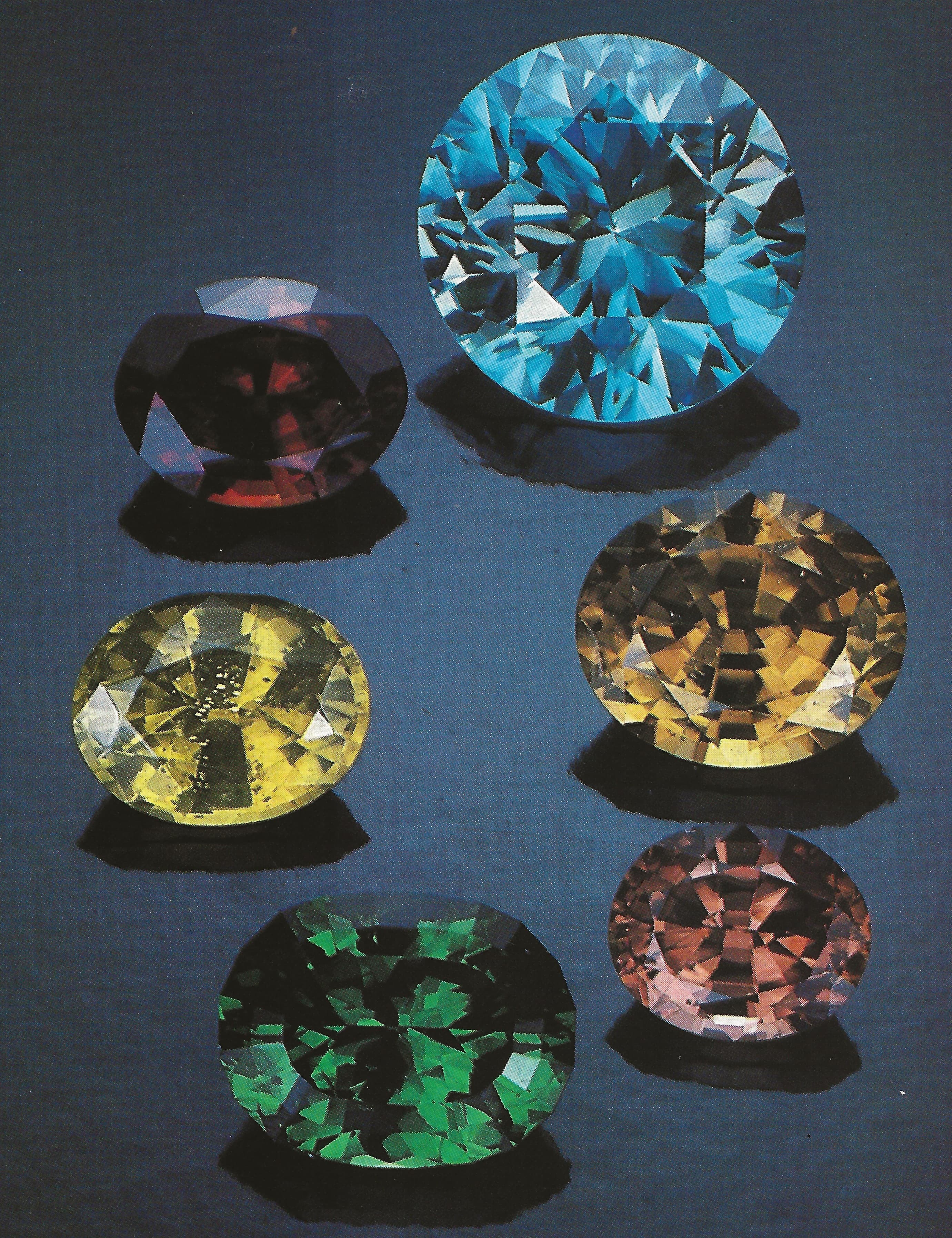
A diamond by any other name is a zircon. Or it was for a couple of centuries, one of them ours.
Since the mid-1970s, however, a diamond by any other name is more likely to be cubic zirconia.
Due to the name similarity, many new jewelers assume that zircon, a natural diamond substitute, and cubic zirconia, a man-made diamond simulant, are one and the same – or closely related. They’re not. But the widespread belief that they are stymied efforts on the part of zircon zealots to improve the much-maligned reputation of this gem. Many devotees protest the backhanded treatment zircon, the December birthstone, receives.
Yet zircon isn’t the first birthstone to find its birthstone status more a hindrance than a help. Reflect for a moment on spinel, a gem in chronic low standing with those legions of jewelers who refuse to believe it anything but a cheap mass-production synthetic. And the fact that a major number of antiquity’s finest and rarest rubies have been identified as natural spinel doesn’t seem to change matters.
So it goes with some birthstones. The irony of all this is that zircon enjoys a rather formidable status among gem collectors. Indeed, like corundum and tourmaline, the gem comes in a wide enough variety of colors – blue, green, yellow, orange, red and brown – to make collecting it a specialty in itself. “I know that half the zircons I sell to jewelers will never make it to their showcases,” says gem dealer and zircon enthusiast Simon Watt, Mayer & Watt, Beverly Hills, Calif. “They’re buying the stones to keep for themselves.”
The stigma story
To be sure, such jewelers are few in number. Watt estimates that he has sold no more than a dozen zircons in the last year or so. “But none of them were colorless,” he adds. “Anybody familiar with zircon knows that other gems do a much better job of imitating diamond.”
That evidently wasn’t the case a century or two ago, perhaps more, when gem dealers discovered that heating cinnamon-colored zircons often made them colorless, more brilliant and, well, highly reminiscent of you-know-what. From then on, the gem was largely but not entirely thought of as a poor man’s diamond, although for years the trade disguised the pretender status for these cooked-to-colorless stones by calling them “Matura diamonds” in honor (or dishonor) of the place in Sri Lanka where they were mostly found. (Nowadays, far more jewelry-grade zircons are found in Southeast Asia, particularly Thailand and Cambodia.)
Not all in the trade looked down on zircon. To their everlasting credit, a number of Thai dealers tried marketing blue zircon as “Starlite” (a tribute to its highly refractive nature) sometime in the mid-1920s. Although this name never caught on, it represents the most notable attempt at positive thinking about zircon ever launched in the gem trade.
Those dealers were right to celebrate zircon. The gem is practically its own rainbow – even without application of heat treatment. Nevertheless, this form of color alchemy is responsible for the chief zircon varieties – colorless, blue and gold – that have been used in jewelry. With such a wide palette of color to offer, zircon has managed to withstand the diamond substitute stigma. But it has never dealt that stigma a crushing blow.
Beyond blue
Strangely enough, many of the relative few who think of zircon only as a colored stone, not a diamond look-alike, still fail to do this gem full justice. Dealers who stock zircon in depth tell us that at least 80% of their zircon sales are in one color: blue. This blue is one often reminiscent of grey-tinged African and Indian aquamarine, even “London-blue” irradiated topaz. Occasionally, stones are said to verge on sapphire blue.
Because it comes in such pleasing blue shades, it is easy to understand why blue zircon was used frequently in Victorian jewelry, especially in the 1880s. Indeed, Victorian jewelry is one of the principal sources of large zircons over 5 carats nowadays. “When I’m in England,” says British-born Watt, “I often see zircon jewelry in fine antique shops. Invariably the stones are blue.”
Given the preponderance of blue zircon in the better antique zircon jewelry that he sees, Watt suspects that many of the calls he gets for blue zircons are as replacement stones for estate pieces. Just in case you may need such a replacement stone, be advised that prices of better-to-fine blue zircons currently range from $75 to $150 per carat in sizes up to 5 carats. Exceedingly scarce larger blue stones could hit, perhaps top, $200 per carat.
No doubt, the surprisingly high cost of blue zircon will discourage some jewelers from using it, especially since premier-grade blue topaz is available for $20 per carat and less in large sizes. But if cost discourages use of blue zircon, then consider other colors of this species. Zircons ranging in color from brownish-yellow to reddish-brown can be bought for anywhere from $15 to $30 per carat in 2 to 5 carat sizes, making them quite a bargain. What’s more, says Cynthia Rodrick of Pala International, the Fallbrook, Calif., firm whose stones are pictured on the preceding page, these affordable zircons “fit right in with the increasing use of earth colors in this fall’s jewelry.”
Brilliant and brittle
Jewelers tempted to finally experiment with zircon should know about some of this gem’s characteristics. Those who have seen used jewelry with zircon in it already know this stone is brittle. That is usually evident from abraded facet junctures, a problem remedied by repolishing. To keep future wear and tear of zircons to a minimum, keep stones out of rings and instead put them in brooches, pendants, earrings and pins. By the way, earth-stone zircons are ideal for men’s tie-tacks, stick pins and other dress-up jewelry.
Besides brittleness, many unheated zircons possess a cloudy or smoky appearance that may, if too pronounced, be a minus. Interestingly, however, smoky pale-grey zircons were once commonly used in “mourning” jewelry.
In zircon’s favor is its great brilliance and fire, near enough, as said before, to diamond to fool the unaided eye. Fortunately, zircon is doubly refractive and diamond singly refractive. So it’s easy to tell the two apart if questions arise.
To take fullest advantage of zircon’s great luster, stones are usually cut into rounds, albeit modified ones with an additional set of pavilion facets. But among zircon dealer/connoisseurs, emerald shapes seem more highly prized. The reason? “You’ll know when you see one,” answers Watt.
The zircons were provided by Pala International, Fallbrook, Calif. From the top starting with the 16.48-carat blue zircon and clockwise is a 7.30-carat gold-colored zircon, a 3.4-carat light brown, a 6.44-carat green, a 4.41-carat yellow and a 5.28-carat burgundy-colored zircon.