Turquoise
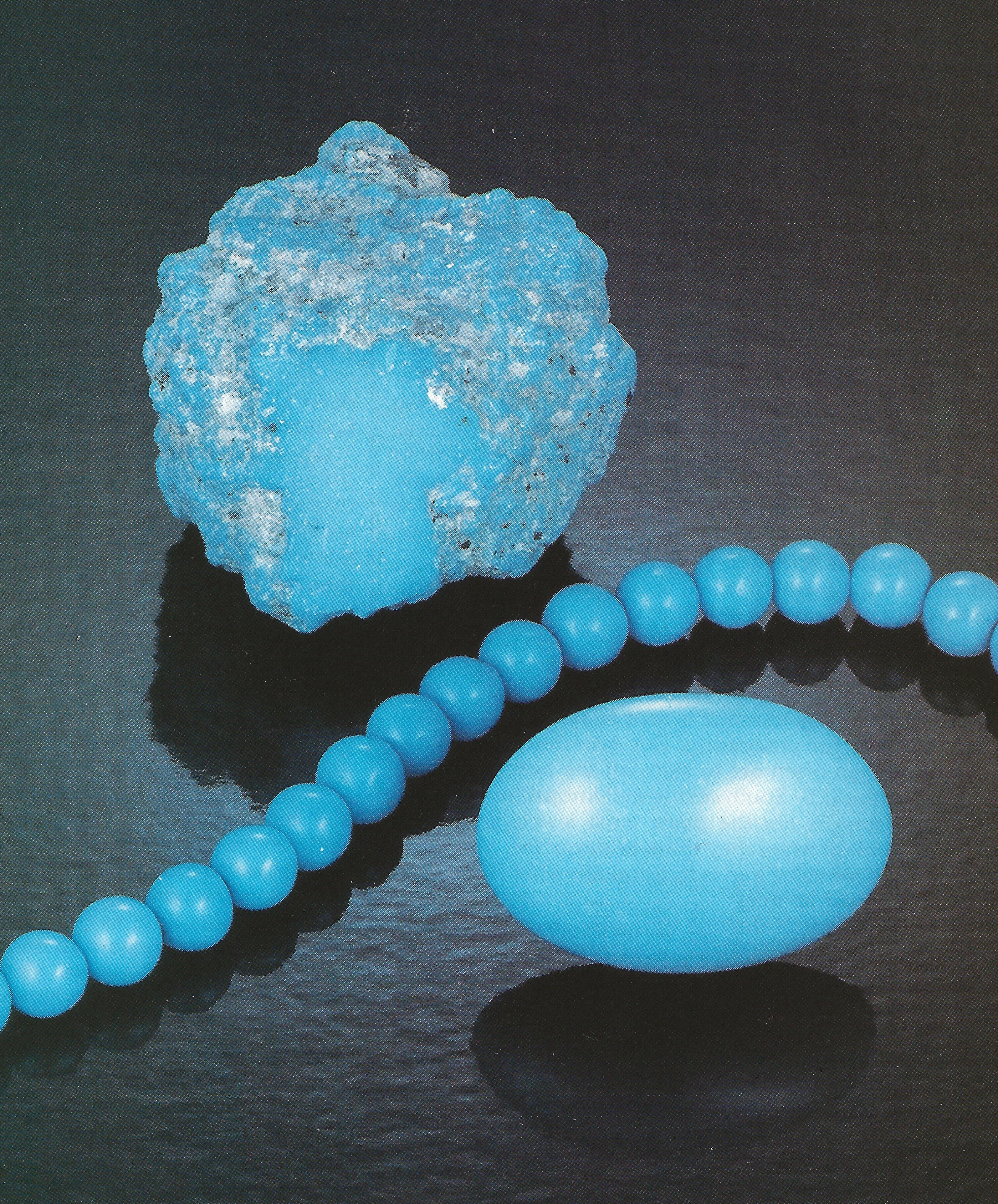
This sky-blue color copper derivative, so important to the ancient Egyptians and Aztecs, has known better times.
Perhaps the best times of all for this gem were the late 1960s when social awareness briefly held more sway in U.S. fashion trends than the social registry. Back then, American Indian jewelry was powerfully in vogue and turquoise, the gem most associated with it, was hot.
But once so-called native Indian jewelry started coming from Hong Kong and Taiwan, with its turquoise often plastic-treated or just plain plastic altogether, the gem’s popularity nosedived. It didn’t help matters when a major tribe of the Southwest was found to have mass-produced some of the silver and turquoise jewelry in Asia that it had been selling as handmade in the U.S.A.
Such scandals devastated the reputation of a gem that is as strongly linked to centuries of skillful jewelry artisanry and other decorative arts as amber and ivory. Yet even with such scandals, there were still small but evidently gold-lined pockets of connoisseurship for this gem. Los Angeles turquoise specialist Roben Hagobian recalls prices to Iranian collectors of as much as $2,000 per piece for top-echelon 15x20mm turquoise cabochons as late as 1976 – three years before the fall of the Shah in 1979.
A decade later, it is doubtful that the finest turquoise could fetch anywhere near the price, unless a part of an important piece of antique jewelry. The sad truth about this gem is that rampant adulteration, plus a profusion of fakes, has cost it much of the public’s trust. But even without much publicized high-tech shenanigans, turquoise would probably have difficulty commanding big bucks today.
Persia spelled A-R-I-Z-O-N-A
Like copper, the metal of which the gem is a byproduct, turquoise is super-abundant at a time when demand has slackened considerably. The end-result: ravaged prices. Indeed, output from turquoise mines in Arizona alone, presently the gem’s biggest producer, is said to be around 1,500 tons a week. Most of this tonnage is sent to Hong Kong and increasingly Italy for processing. But American dealers like Roben Hagobian often get to skim off the best grades.
Although the U.S. Southwest is well-known for turquoise mining, Arizona is not the place most jewelers and connoisseurs think of when they think of turquoise. Very likely Iran comes to mind for Iran is to turquoise what Burma is to ruby: the premier source.
That’s why much of the fine turquoise sold today is sold as Persian. Only it’s not. Mining activity in Iran is negligible at best. “Most of the turquoise sold as Persian today really comes from America,” says Hagobian.
Many readers might find this evidence of continued turquoise charlatanry. But, in reality, American turquoise boasts its own grand, but far less celebrated heritage, a heritage Americans unconsciously honored when Indian jewelry was all the rage 15 to 20 years ago.
Memories of Mexico
American Indian jewelry is primarily identified with two tribes, the Pueblo and Navaho. Actually, however, turquoise veneration and use reaches back centuries to the time when New Mexico, a major U.S. turquoise locality, was a part of the great Aztec empire of Mexico (1300 to 1520 A.D.). To the Aztecs, turquoise was more valuable than gold and a principal decorative medium. Even after the fall of the Aztec empire to the Spaniards, turquoise maintained its importance to the Indians, despite brutal attempts by their oppressors to confiscate it.
Few know it, but turquoise is synonymous with political liberation to the Pueblo tribe. For more than a century, its members were forced to work both underground and open-pit turquoise mines for Mexico’s Spanish conquerors. Then, in 1680, after a major mine cave-in killed scores of workers, the Indians refused to work. Instead, they staged a rebellion and drove the Spaniards from their lands.
Such victories over what today is called imperialism would have probably added even more to the pleasure of turquoise ownership back in the Viet Nam era. But the intricate involvement of turquoise in Mexican and U.S. political history was pretty much ignored then – and now. No wonder some turquoise zealots consider it a mark of alienation from our past that more reverence is given to the Persian rather than the American variety of this gem. But defenders of Persian turquoise say the preference is based, as it should be, on aesthetics.
The blue sky ideal
Talk of ideal color in turquoise today is, admittedly, a little beside the point since manufacturers here and abroad are reluctant to pay any more than $3 per carat for the oval, pearl and round cabochons they buy. Usually, $1 per carat is more like it. For this kind of money, they generally receive mild to medium sky-blue colors, rarely, if ever, the intense deep blue azures extolled by the experts. However, fairly bold blue cabs are available at around $4 to $6 per carat.
Given the extremely low prices of high-grade natural turquoise, it is somewhat amazing to find a thriving market in treated material. The market is as old as love of turquoise – with imitations traced back to ancient Egypt. But the ancient imitations made sense because the gem was then genuinely precious, not to mention scarce relative to demand.
By the late 19th century, however, when fine turquoise was quite inexpensive, the tricks played with turquoise were much harder to condone. The great American gemologist George F. Kunz caused a sensation when he exposed the infamous “Berlin-blue” dyeing technique around 1900. But detection didn’t deter even more ingenious deceits.
That’s the biggest threat to the turquoise market today: ever more clever forms of doctoring such as stabilization with polymer binders to increase durability. While polymerized turquoise is understandable given the fact that the gem is very soft and porous, some recent laboratory concoctions that contain as little as 5% of this mineral are not. Such fakes are especially hard to countenance given all the natural turquoise and natural turquoise substitutes such as azurite and chrysocolla on hand at rock-bottom prices.
The turquoise pieces shown on the preceding page, including 4½ mm bead strand and 20x15mm cabochon, were provided by R.H. & Co. Los Angeles, Calif.