Fire Opal
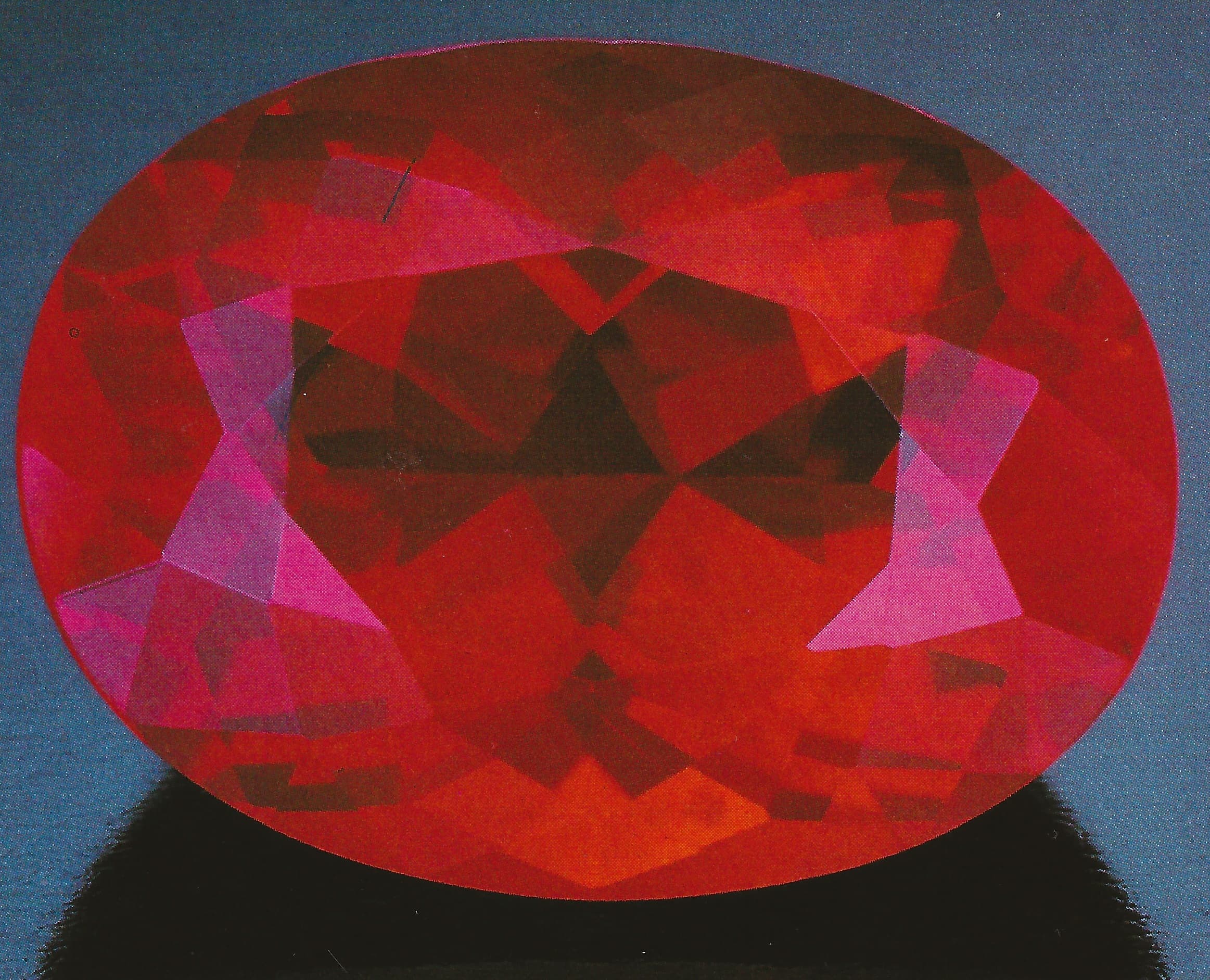
“Pssst, want to buy an opal?”
It’s not exactly what you’d expect to hear in the thronging tourist thoroughfares of Mexico City as one shops for native wares. But, believe it or not, this silicate is a common street corner commodity throughout the country’s tourist areas. And it has been so for years. “I couldn’t believe my eyes,” says eminent gemologist Cap Beesley about his first trip to Mexico City 20 years ago in search of opal. “Everyone was hustling the stuff.”
Few Americans are ready for the sight of opal in profusion during their stays south of the border. That’s understandable since the gem is associated with Australia. Nevertheless, while no rival to Australia in terms of production, Mexico has come into its own as an opal source. Indeed, the country’s opal is so different from Aussie material that it has earned its own name, fire opal, and its own following.
But don’t hope to be shown connoisseur-class material on Mexico City’s crowded sidewalks or even in its more private alleys unless you’re prepared to spend days looking. The country’s street-corner opals are often similar in quality to the street-corner rubies so many GIs brought back home from Thailand during the Vietnam War.
Dealers who specialize in Mexican fire opal, of which there are probably less than half a dozen in America, find their chances of buying the more venerable varieties of this stone much better at the Tucson Gem Show every February and far better yet in Idar-Oberstein where savvy German cutters have been importing most of Mexico’s best opal rough for decades.
Great Balls of Fire
At their best, Mexican fire opals possess either flaming orange or cherry-red body color that is uniform and solid – as opposed to the iridescent streaks, patches or flecks of color in fine Australian opal. If roughs are transparent or sufficiently translucent, they will be faceted rather than cut into cabochons.
This isn’t to say that Mexico doesn’t produce Australian-like color-play opal suitable for cabochon cutting. According to cutter Uli Mayer, Mayer & Watt, Beverly Hills, Calif., top color-play opals from Mexico rival those from “Down Under” except that the South American variety tend to array their colors against orange, instead of white, backgrounds. Since scarce better-to-fine Mexican color-play cabs in sizes over 2 carats currently command $200 to $300 per carat at wholesale in the Japanese market, U.S. jewelers understandably prefer far more abundant and reasonably priced Australian stones.
But when it comes to deep body-color opals, whether cabbed or faceted, they have no choice. Mexican stones are the only game in town. At present, it’s a game with relatively few stateside players. And if the dollar weakens significantly again, the number of players will only decrease. “With fire opal becoming more popular in strong-currency countries like Japan and England, cutters in Idar find they can ask significantly more for stones,” explains fire opal specialist Bill Heher, Heher Enterprises, Trumbull, Conn. “Consequently, the market is shifting more and more abroad because jewelers in this country aren’t ready yet to absorb steady price jumps.”
No doubt about it, prices for fine fire opal are climbing, easily 40% in the last two years, with most of the gains in the past six or so months. Yet despite its surging cost, the stone still strikes us as affordable, especially in light of its scarcity. The maximum dealer-to-jeweler price we were quoted for top cherry-red stones in a 5-carat size was $200 per carat. More plentiful 1- to 2-carat sizes shouldn’t run above $150 per carat. Pieces with deep fireball oranges from 1 to 2 carats will probably ring in to jewelry stores at under $125 per carat while those in the same sizes with medium-intensity orange-peel colors should carry tags of no more than $80 per carat.
The Crazing Factor
Like all opal, the Mexican variety can crack in the course of time. What percentage of stones will be so afflicted is impossible to say.
Fire opal specialists do not deny that crazing is a problem. But they quickly add that the problem is exaggerated. Further, they believe that they effectively circumvent it by subjecting stones to fairly intensive screening.
“First of all, we put stones on a mild heat radiator set at 80 degrees Fahrenheit for ten days,” says cutter Mayer. “If problems develop, the stone is rejected.”
If problems don’t emerge, that doesn’t mean the stone is out of the woods. Mayer estimates that around 10% of the stones that make it past this initial heat test will start to crack up during the first stages of cutting, otherwise known as pre-forming. Tiny milky dots or larger spots are generally tell-tale signs that the stone could possibly go to pieces if kept on the wheel. Although Mayer immediately throws away such pieces, there are those who may not be so scrupulous. Beesley remembers being shown some partially formed street corner opals in Mexico that were incompletely cut because cracking had developed while processing them. To disguise cracks, sellers had bathed stones in oil.
As for stones which make it unscathed through cutting, there may be one or two which crack later. But specialists we talked to insist this almost never happens. “I’ve sold 1,500 stones in the last decade without one problem,” says Heher. He attributes his good luck with fire opal to his fastidious selection process of rough material. While not as fortunate as Heher, Mayer, a major processor of fire opal, says screening has, for the most part, spared him from customer complaints. Even so, he takes no chances. “Since troubles occur within a short time after stones leave my inventory, I guarantee every fire opal I sell for one year from date of sale,” he says.
Because fire opal, like all opal, is somewhat high-strung, it is best to consider it a fragile stone, far more appropriate for use in pendants or earrings. This is not to rule out ring use altogether. But jewelers who sell stones in such settings should feel an ethical obligation to advise customers about the consequences of lackadaisical, everyday wearing.
The 10-carat fire opal is courtesy of Heher Enterprises, Trumbull, Conn.