Chrome Tourmaline
Are the wives of African miner Ali Giowatta once again on speaking terms?
Judging from the increased supply of chrome tourmaline in the past few months, it would seem so.
Giowatta, a Muslim, owned the world’s only two chrome tourmaline mines, both located in northern Tanzania. When he died in December 1980, a bitter battle for control of the mines broke out between his three wives. This feud brought the mines’ already-sporadic production to a halt. The world had to depend on dealer backlogs of this gem, many of them in Idar-Oberstein, Germany’s great cutting center.
In any case, “chromes” (as they are sometimes called) are suddenly popping up in greater numbers in Nairobi, Kenya – East Africa’s gem city contender to Bangkok. “I’ve seen more chrome tourmalines this past summer than in the preceding year and a half,” says tourmaline expert Josh Hall, Pala Properties International, Fallbrook, Calif.
Hall hasn’t decided if the pickup in supply has to do with restored domestic tranquility among Giowatta’s heirs or the fact that Tanzania, a Socialist country, has opened its borders to its capitalistic neighbor, Kenya. Since the bettering of border ties took place a year ago, and the resumption of chrome tourmaline supply is less than six months old, he favors the first explanation.
No matter, chrome tourmaline is back. Indeed, it is back in some of the best green shades ever seen for this gem. But then green is a gem color in which East Africa excels. This is partly why chrome tourmaline is the most expensive green tourmaline in the world.
A Clean Green
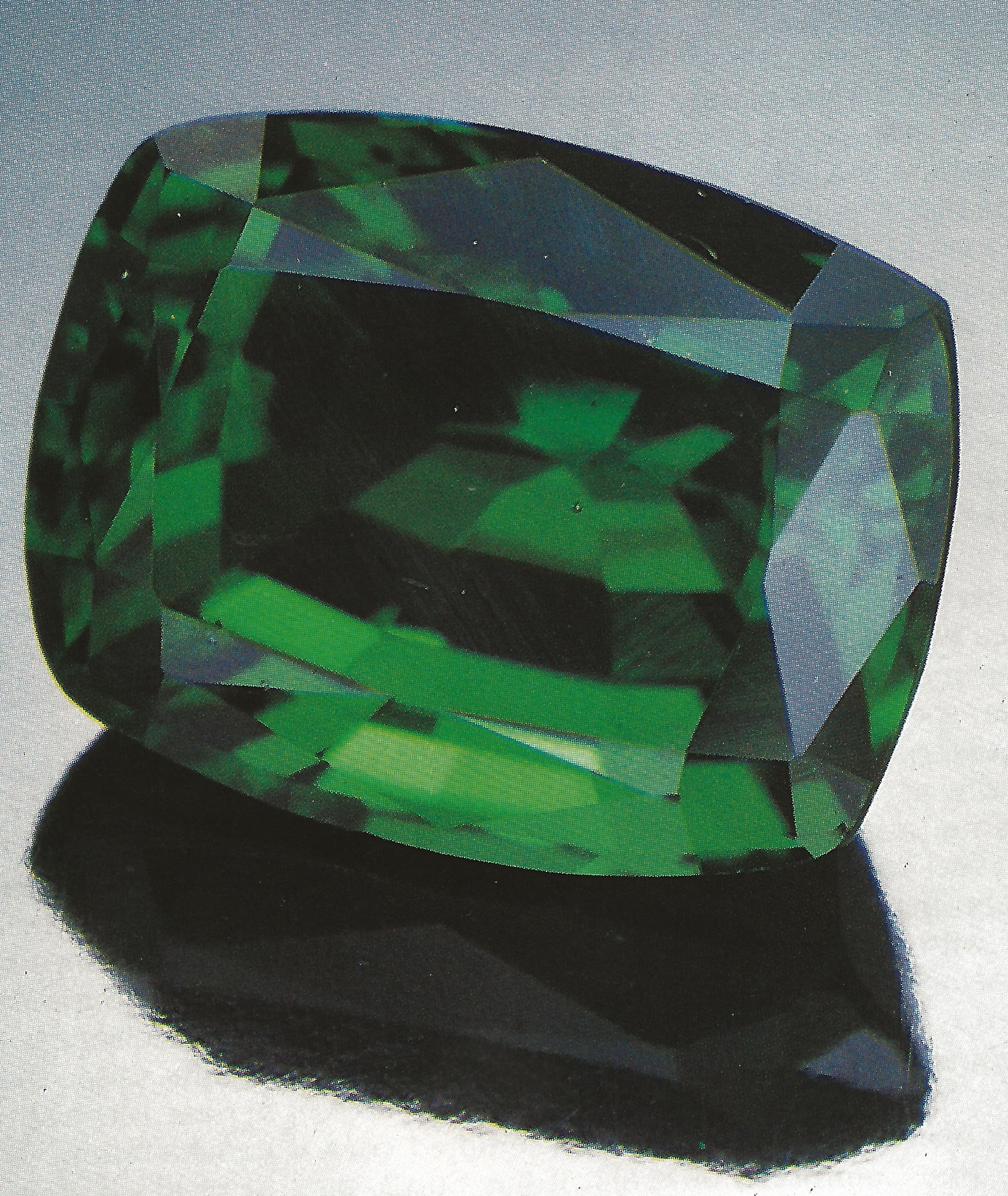
Like East Africa’s far more widely known green gem, tsavorite garnet, chrome tourmaline is noted for a rich, bright, clean color that, specialists insist, is visually distinctive and has no real counterpart among other tourmalines. Indeed, novices are more apt to confuse fine chrome tourmaline with fine tsavorite. They shouldn’t feel bad, however. So do the experts. “The finest quality chrome tourmalines are only distinguishable from tsavorite with the aid of gemological instrument such as refractometer,” says Colin Curtis, Gemological Exploration Corp., Tustin, Calif. (The refractive index of chrome tourmaline is usually 1.62–1.64 while that of tsavorite is 1.74.)
Very recently, some superb stones have tempted comparison to very fine Colombian emerald. Colin Curtis, an expert in East African gems who spends much of his time in Nairobi, reports that some newer material sports a “lovely bluish-green cast.” One of these stones, on display at the recent American Gem Trade Association show in New York City, resembled a spectacular emerald. Weighing over 8 carats, its owner, dealer Isaac Aharoni, wanted $1,000 per carat for it – by far the highest price we have ever heard asked for a chrome tourmaline!
But it was an outstandingly beautiful stone, perhaps one of a kind (we have yet to see its second). More commonly, very fine chrome tourmalines lean more toward the yellow than the blue end of the spectrum. But whether yellowish or bluish, their chromium content is what gives them their bright, sharp, vivid color. Jewelers can even test for chromium content with a Chelsea filter. Under the filter, chrome-laden stones will show flashes of red or orangey-red.
The Chelsea test is the main way dealers confirm the East African origin of tourmaline. Far more abundant green tourmalines from Brazil, Afghanistan, Maine and California are colored primarily by iron. So, when these stones are subjected to a Chelsea filter test, their color remains green.
Even without a filter, dealers versed in tourmaline say “chromes” have a unique visual appeal. At their best, they boast an almost corrosively brilliant color. Of course, this uniqueness is reflected in their prices which generally, says Josh Hall, are three times that of any other green tourmaline. Our wholesale price survey puts better-to-fine chrome tourmaline at $150–$300 per carat in sizes through 5 carats, as high as $600 per carat for exceptional 8–10 carat stones.
Caught in the Middle
Although chrome tourmaline is scarcer than tsavorite, it occurs in a far greater size spread, anywhere up to 10 carats, with frequency. On the other hand, tsavorite in sizes over 2 carats is extremely hard to come by. For this reason, top-grade tsavorites around 2 carats easily command $1,500 per carat, sometimes closer to $2,000 per carat. (Comparable 1 carat stones fetch $800–$1,200 per carat.) Kindred-caliber chrome tourmalines around 2 carats will cost jewelers only $150–$200 per carat. That makes them 1/10th the price.
Yet demand for chrome tourmaline is probably less than 1/100th than that for tsavorite. Why? “Jewelers don’t think of chrome tourmaline as a bargain compared to tsavorite,” says dealer Alex Bahtiarian, Englewood, N.J. “They think of it as very expensive tourmaline.”
This is not to say that chrome tourmaline doesn’t have its followers. Usage is increasing among jewelers and jewelry manufacturers. Virtually unknown before 1970, this tourmaline has now become the color standard for deep-green in this gem. We think it has something to do with East Africa and the special aura that surrounds its gems.
A word of caution is necessary here, though. Many chrome tourmalines do not possess the fine green we are describing and for which we are quoting prices. According to Colin Curtis, only one of the two Tanzanian mines that produce this gem can be counted on for a fairly steady but thin flow of fine stones. It is called the Landanai mine and its stones are usually free of the brownish overtones that mar the tourmalines from its more productive sister mine.
Brownishness isn’t the only problem with chrome tourmaline. Often stones will be so saturated with green that they appear blackish or over dark. Unless price is your prime consideration, we advise steering clear of either brownish or blackish stones. “If you must compromise,” says Colin Curtis, “go with lighter, livelier stones. The dark, somber-colored ones are almost impossible to sell.”
One last tip: Expect stones to be eye-clean. “A small wispy veil might be okay,” says Josh Hall. “But stones shouldn’t be what you would call included.”
The 2.39 ct. chrome tourmaline was provided courtesy of Overland Gems, Los Angeles.