Chinese Freshwater Pearls
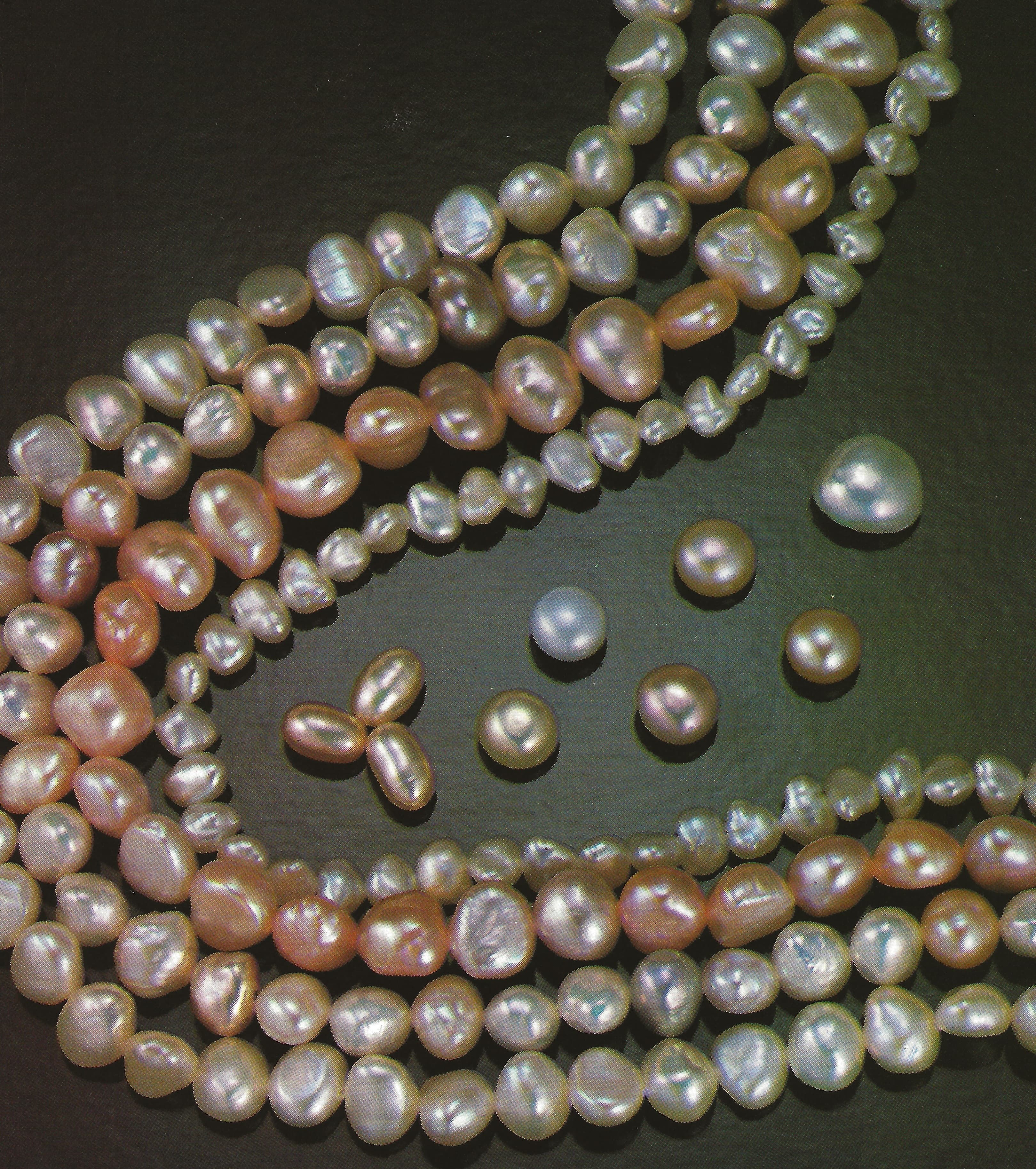
Quantity kills quality.
As an example, we cite the Shanghai lake district of China, the world’s prime producer of freshwater cultured pearls. To boost harvests of these very popular pearls, most of which resemble rice krispies, the Chinese government has turned pearl farming there (and elsewhere throughout the country) into something of a numbers game with growers paid purely by pearl weight not worth. U.S. dealers who buy direct from the Chinese say this weight-over-worth policy has worked to swell output, currently estimated at between 75 and 80 tons annually – but at the expense of top grades. Only a decade ago, better goods accounted for a far more substantial share of overall production. Now they make up, some dealers insist, less than 10% of the country’s annual pearl crop. And the percentage is shrinking fast.
“I’m seriously worried about the future of quality pearls from China,” says Jesse August, the August Corp., New York City, a regular traveler to China. August isn’t the only dealer with such concern.
The Big Shell Out
In the name of numbers, Chinese pearl farmers switched from the slow-grow sankaku to the fast-grow kurasu mussel during the late 1970s. Use of the kurasu mussel – which Jesse August estimates now accounts for 80% of Chinese freshwater pearl production – has cut cultivation time from 36 to as little as 12 months.
But abbreviated growing cycles take a heavy toll in terms of pearl beauty. Nearly all kurasu pearls lack the smooth, lustrous surfaces of their sankaku counterparts. Instead, they are wrinkled and dull, often severely so. Shorter shell life also contributes to a marked decline in production of symmetrical shapes. “The Chinese are harvesting, for the most part, between 12 and 18 months,” says U.S.-based pearl farmer John Latendresse, American Pearl Co., Camden, Tenn. “Your chances of getting symmetrical shapes are much better if you leave the pearl at least two years.”
This isn’t to say that shorter growing cycles are the sole reason for Chinese pearl quality problems. Overcrowding of some lakes and ponds starves mussels of necessary nutrients to make fine pearls. And the comparative lack of Chinese pearl culturing know-how compounds the situation. “For 17 cents an hour, you’re not going to find technicians who know the niceties of pearl cultivation,” Latendresse declares.
Learning those niceties is the key to the future of the Chinese pearl industry. Despite experiments cross-implanting the tissue of the kurasu into the sankaku mussel for more shapely, less afflicted pearl growth, many Chinese pearl technicians lack the profound sensitivity and skill – traits their Japanese counterparts possess – to make these experiments in pearl improvement succeed.
Proper insertion of mantle tissue is essential for decent freshwater pearls. Unlike Japanese akoya and South Sea saltwater cultured pearls, Chinese freshwater pearls contain no shell-bead nucleus to force spherical or, at least, symmetrical growth. Only sections of tissue from sister mussels are used, sometimes as many as 50 to a mussel, but usually closer to 25.
The Shanghai/Biwa Connection
China’s lack of sophistication with regard to pearl technology, coupled with its sheer-volume philosophy, put the country in a bind it is having difficulty escaping. At least 80% (Latendresse insists it’s 90%) of the country’s yearly pearl harvests are rice pearls, 16-inch strands of which are readily available for as little as $1–$2 in Hong Kong and Taiwan. This abundance of low-grade material only reinforces China’s image as a second-class pearl power. Indeed, her best off-round and symmetrical pearls in 7mm sizes are lucky to command $6 per piece – even with fetching natural pink colors.
Yet many of these same pearls command three to five times this price in Japan where they are sometimes sold as pearls from that island’s famed Lake Biwa, an area so ravaged by pollution that the pearl-mussel mortality rate is reported running at 60% to 70%. Within a year or so, production there may stop altogether. Nevertheless, few jewelers would guess that the lake is a mollusk death trap because of the large numbers of pearls that continue to be sold as Biwa in origin.
Statements that pearls from China’s Lake Shanghai (or any other Chinese lake for that matter) come from Japan’s Lake Biwa are “clearly deceptive and violate the law,” says Joel Windman, general counsel of the Jewelers Vigilance Committee. Yet, maintains John Latendresse, some dealers here and abroad rationalize such misrepresentations by arguing that Japanese high-tech enhancements of Chinese pearls make them, in effect, a Japanese product.
That’s stretching things. Nevertheless, many dealers who reject calling Chinese freshwater pearls Biwa have no qualms about labeling them as “Biwa-type” or “Biwa-like.” New York-based pearl publicist Alan Macnow thinks this is equally wrong. “It’s deceptive to make an origin term like ‘Biwa’ into a generic term,” he says. “I have never seen a Chinese freshwater pearl equal in quality to the Japanese variety. Use of ‘Biwa-type’ makes it seem the only difference between the two is geographical.”
Thankfully, the confusion of Chinese with Japanese pearls affects a relatively small percentage of Chinese freshwater pearls. However, with Japanese freshwater production in big trouble, the Chinese have perhaps their greatest opportunity of the past 20 years to upgrade their overall image as a pearl producer or, at least, restore some of its former luster. But given the technology gap between the Chinese and the Japanese, this will be difficult. The Chinese have some catching up to do.
But it’s highly doubtful that the Japanese, the most logical choice for technical assistance, will be open to any type of pearl pacts with the Chinese. They remember all too well how they were ejected from Burma after helping to make that country’s pearl farms among the finest in the world. Nevertheless, the Chinese have tried several times to interest the Japanese in joint venture pearl farming, always without success. “The Chinese are caught in a severe bind,” Latendresse observes. “During Mao’s Cultural Revolution, the government closed nearly all the universities and pretty much deprived a whole generation of higher education. Just how far can China go it alone as a pearl power without, for example, marine biologists?”
Chinese freshwater pearls courtesy of K.C. Bell of K.C.B. & Associates, Santa Monica, Calif.