Burma Sapphire
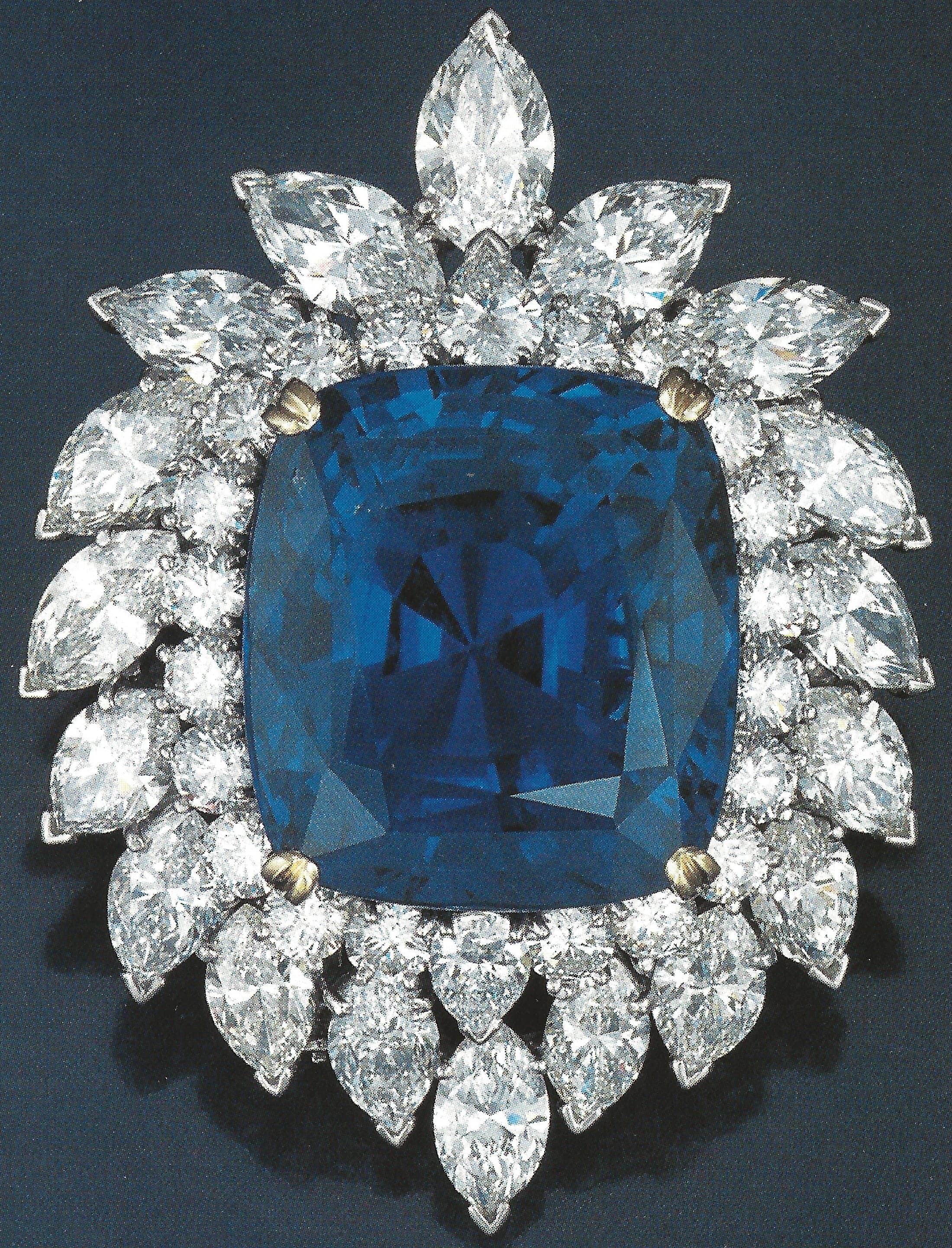
Three times since 1971, a sizeable Burma sapphire, owned by John D. Rockefeller Jr. and now named after him, has come up for auction at Sotheby’s. All three times the stone was bought by the same New York fine gem specialist, Ralph Esmerian. So great is his esteem for the 62.02-carat emerald cut that he paid $2.85 million ($46,000 per carat) to re-acquire it the last time the behemoth hit the block at a St. Moritz sale in February 1988. That was top dollar for a Burma sapphire then. Come to think of it, so was the $1.5 million Esmerian and his father paid for the stone in May 1980, as was the $200,000 they spent to obtain it in November 1971.
Some dealers versed in upper echelon sapphire don’t feel quite as keen as Esmerian about the stone. But that’s the funny thing about fine Burma sapphire. Unlike exemplars of the Kashmir variety, the best of Burma rarely elicit the same unanimity of praise from dealers. But there are enough tastes that agree with Esmerian to make Burma sapphire a secure No. 2 on the totem pole of connoisseur preferences for sapphire – one notch below Kashmir’s best and one notch above Sri Lanka’s.
Still, what is it about Burma’s blues that leaves dealers divided in their opinions about it? Seeing the Rockefeller sapphire answered this question.
Tone Problems
At a glance, the Rockefeller stone explains why Burma’s blue is so revered. Its color is royal, vivid and electric. Just as striking: the blue is so rich that it seems to be deposited in solid sheets. Although fine Sri Lankan stones often exhibit a similar blue, their color generally appears more watery and less forceful. (Kashmir color is of a different – and, most agree, higher – order of magnificence: softer, lighter-toned, more velvety.)
So much for the considerable pluses of Burma blue sapphire. If the Rockefeller sapphire has any drawbacks, it is its deep tone. “The blue is a bit over-intense,” says Reggie Miller, the New York lapidary who recut the stone from 66.03 to 62.02 carats in the early 1970s. “It’s a problem, with this breed that their color runs so strong, stones are often too dark.”
Miller’s observation is one Burma sapphires have encountered for a long time. No admirer of these stones, gemologist Max Bauer wrote in 1903 that their color “is usually so dark that they appear almost black.” Adding insult to injury, he next noted that “they are seldom comparable in quality with those from Siam [Thailand], and do not command a high price.”
Although sapphires from Thailand’s nearly exhausted deposit at Chantaburi have long been admired, it is hard to believe they once fetched more than Burma’s best. Were turn-of-the-century tastes so much different from our own? That’s the only explanation we can give for the sapphire value situation circa 1900.
Of course, cynics might say that heating, a big factor in the rehabilitation of many Australian, Sri Lankan and Thai sapphires, has also played a role in the vastly improved fortunes of Burma sapphire. But treatment detection expert Cap Beesley of American Gemological Laboratories, New York, doubts it. “Burma stones don’t respond as well to heat as Sri Lankan or Kashmir stones,” he maintains.
News to Most
To the average jeweler, aesthetics debates over Burma sapphires may come as a bit of a surprise. Although Burma stones have been prominently featured at recent auctions, this country’s breed, in general, just doesn’t receive as much press as those of other origins. It is probably safer to assume that jewelers have read more about long-running sapphire mines in Montana or newer finds in Nigeria than ancient deposits in Burma.
Yet, amazingly, Burma stones nab sums of money second only to those paid for Kashmir stones. And they’ve been doing so for several decades. So why don’t jewelers read all that much about them? We think it is because Burma sapphires, as beautiful as they are, have long been overshadowed by the country’s stellar rubies – both of which come, in the main, from the legendary Mogok tract. According to Max Bauer, Burma’s late 19th century production of ruby exceeded that of sapphire by a ratio of 500-to-1! There’s no reason to think the ratio has changed.
Mining methods at Mogok were as primitive when Westerners like Reggie Miller saw them in the early 1960s as in Bauer’s day. And since Burma has regressed technologically since being closed to the outside world after a 1962 military coup, it is safe to assume the 500-to-1 ratio remains intact. To make matters worse, output at once-thriving Mogok is barely a trace of what it was. In short, jewelers don’t hear about Burma sapphires because they were never that plentiful to begin with.
Pedigree Problems
Ironically, although jewelers don’t hear too much of Burma sapphires, chances are good that they’ve seen and possibly even sold them, especially if they’ve been in business for a while. That’s because a good many Burma stones look so much like ones from Sri Lanka that their origin doesn’t warrant much ado. Or didn’t.
Today, being from Burma can justify such high premiums that some unscrupulous dealers hunt out imposter stones from Sri Lanka and sell them as Burma originals. The color, appearance and inner life of these pretenders are so similar to Burma stones that gemstone origin authenticators like Beesley have their hands full sorting them out. That’s why it is nearly impossible to sell a Burma sapphire today without an expert opinion in writing that it is from Burma.
This doesn’t mean that some stones aren’t what Beesley calls “classics” that reveal their Burmese origin the instant they are seen. “A certain number of Burma sapphires, like their brethren ruby, have an intense color that holds up under all lighting conditions – incandescent, fluorescent and daylight,” Beesley explains. “The color is very pure and punchy in a way that most Sri Lanka’s are not.”
While classic Burma stones pose little or no problem for origin authenticators, they represent a relative handful of the stones that are sent to them for study. Most are too close to call. For the safety of their reputation, honest dealers simply allow buyers to assume such stones are Sri Lankan.
To complicate things a bit more, there is still another strain of Burma blue – with lighter stones and a slightly greenish overtone. “Although the color is distinctive, we look for the same internal characteristics associated with darker material before confirming them as Burmese,” Beesley says.
The 65.8-carat Burma sapphire is courtesy of Christie’s, New York.