Burma Ruby
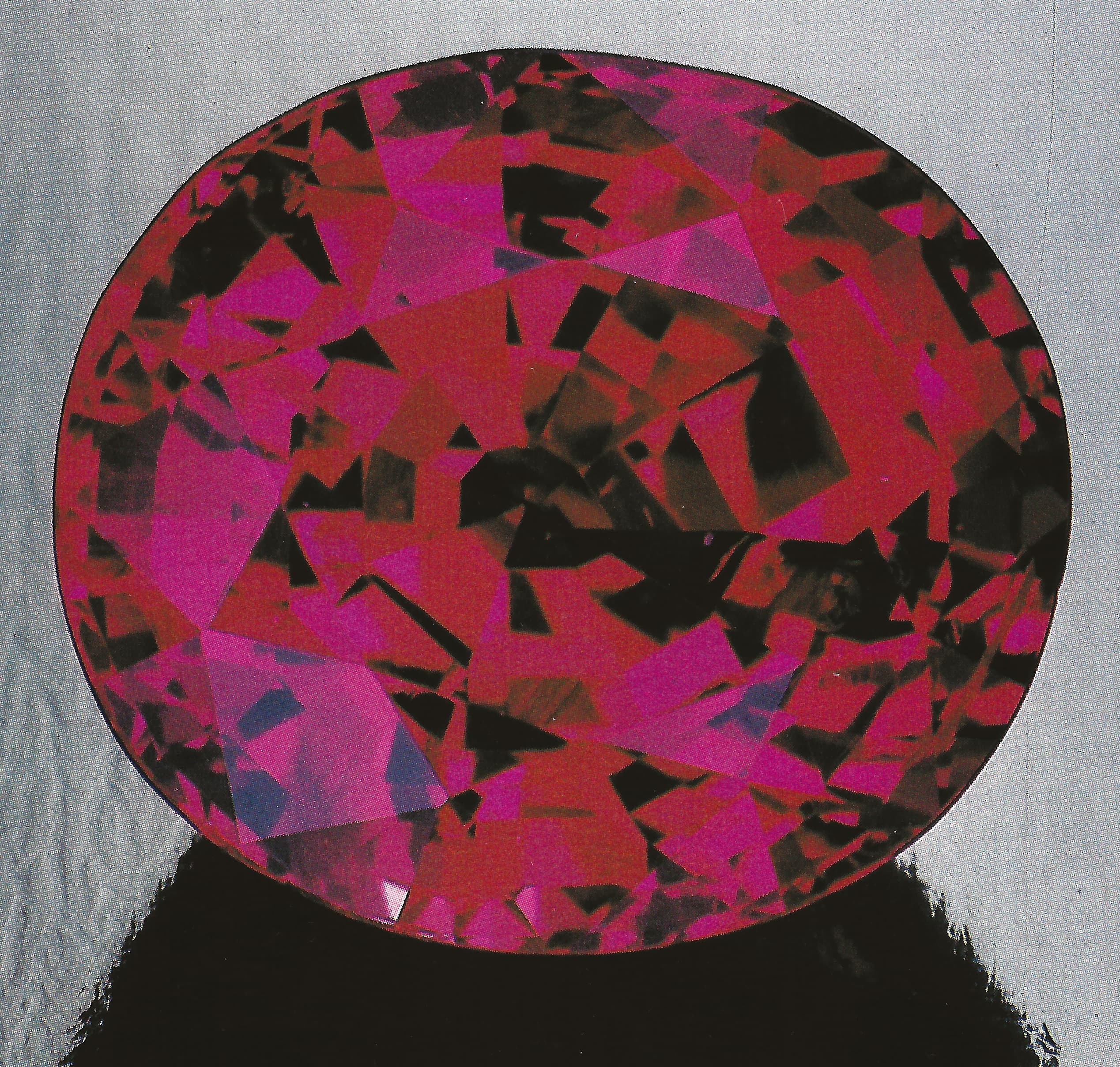
Dealers old enough to remember the golden age 25 years back when Burma ruby was so plentiful there was no need to sell any other variety have had to make a painful peace with stones from substitute sources, mainly Thailand and, more recently, East Africa. Those too young to remember are more skeptical. Were the best Burma rubies of yesteryear really so superior? Or were they, like the beer and belles of bygone days, an over-sentimentalized fantasy?
To decide which, Modern Jeweler’s Yuppie-generation gem market specialist spent a couple of days making cold-eyed comparisons of better-to-fine classification Burma and Thai rubies, hundreds of carats ranging from melee to 5-carat sizes. His conclusion, based on rigorous ogling, was, as distinguished New York City lapidary Reggie Miller assured him it could be, “that Burma ruby has no peer.”
Despite color-bolstering from heat treatment, Thai rubies generally flunk side-by-side savorings with Burma goods. Burma ruby’s vast aesthetic edge became most apparent during a visual blitzkrieg in the office of Maidi and Co., New York City. There one of the firm’s principals, Raphael Maidi, brought out box after box of better-to-fine Burmese and Thai material for our man’s inspection. Able to pit scores of Burma and Thai stones against each other, he could see amazing, often overwhelming, differences in color and appearance.
Although difficult to put into words, the final difference came down to “sex appeal.” For the most part, the Burma stones had a softer, slightly pinker red with lighter tones. The Thai stones, by comparison, seemed harder in color, darker in tone and prone to annoying grays and browns. What’s more, when held at a distance, the color of the Burma stones seemed more pronounced.
Admittedly, all of this is subjective. Quite possibly, some of the stones designated “Burmese” hailed from the increasingly important ruby belt running across adjoining Afghanistan and Pakistan. Others may have been pretenders from Kenya, Tanzania and even Thailand itself. Nevertheless, the overall experience made as profound an impression as any in the editor’s 13 years of jewelry market coverage. Gemologists say such exalted feelings about Burma ruby are hardly surprising. Nature has showered some distinct blessings on this breed.
The Fluorescence Factor
If no longer entirely synonymous with a specific origin, the term “Burma” is still synonymous with ideal beauty in a ruby. Whether a rich solemn intricate red called “pigeon’s blood” or a more bubbly pinkish color called “cherry red,” Burma rubies at their best have a distinctive glow, especially in broad daylight. This glow, explains eminent gemologist Robert Crowningshield of the Gemological Institute of America, is the direct result of fluorescence.
When fluorescent stones are struck by ultraviolet rays, a strong component of sunlight, they excite atoms within. This reaction adds an extra “umph.” Thai rubies almost always lack the vibrancy of their Burma brethren. They are cursed, Crowningshield continues, with the presence of iron, a trace element that affects color for the worse by adding purple and brown, all the while inhibiting fluorescence.
Heating ruby is enough to alter the state of the iron and remove some of the purple and brown. But the process doesn’t significantly boost fluorescence. Hence heated Thai rubies still lack what one dealer calls “jazz.” To a generation reared on Thai ruby, however, there is no way to appreciate this missing ingredient. Hard to define unless seen, it makes it even harder to justify the rather hefty price differentials between Burma and Thai rubies.
Today, for instance, a very fine 3-carat unheated Burma ruby can command around $30,000 per-carat at wholesale. Its Thai counterpart will be lucky to fetch one third. Thankfully, Burma/Thai price differentials narrow as stones get smaller. Very fine all-natural 1-carat Burma rubies currently wholesale for roughly 50% more than very fine 1-carat Thai stones. With fine melee, the Burma premium dwindles to 25%. Not bad considering the desperate disproportion between supplies of Thai and Burma stones.
Give My Regards to Mogok
Ever since Burma’s socialist government sealed off the country in 1962, Burma ruby has been an endangered species. But even before its borders closed, mining in the country’s principal gem tract at Mogok, in north-central Burma, was in sharp decline. Reggie Miller, one of the few American gem dealers alive today to have ever visited Mogok, remembers that as of his last visit in 1960 miners were already re-working the tailings of combed-over deposits. “The future of supply was open to question before Burma became off bounds,” he says.
This isn’t to say that mining has ceased. It is believed to continue, but only in a token and largely clandestine manner. Most of what the West sees in the way of “new” Burma rubies, either those offered at once-a-year gem auctions in Rangoon or smuggled into neighboring Thailand, are probably hoarded goods. The same goes for the majority of Burma rubies sold in major Asian gem centers such as India, Hong Kong and Singapore.
But the Burma ruby supply situation isn’t as yet hopeless. Indeed, says Raphael Maidi, dealers from America are seeing a lot more fine Burma rubies in the past two years. “Because of the dollar’s strength abroad, Americans can easily outbid the Europeans who used to snatch up the better rubies,” Maidi says. “It’s been a good time to buy.”
Alas, it’s been a bad time to sell. Although fine Burma rubies attract handsome sums at major auctions, the connoisseur public’s appetite is nowhere what it was a decade ago. That’s because the main audience for Burma ruby is concentrated in Europe. The strong dollar that is sending more Burma goods here is, unfortunately, keeping them here. “When the dollar returns to reality, I think the recession in stellar gems will finally end,” Reggie Miller comments. “We certainly haven’t heard the last of Burma ruby.”
The Burma ruby pictured is 7.01 ct.