Brazilian Alexandrite
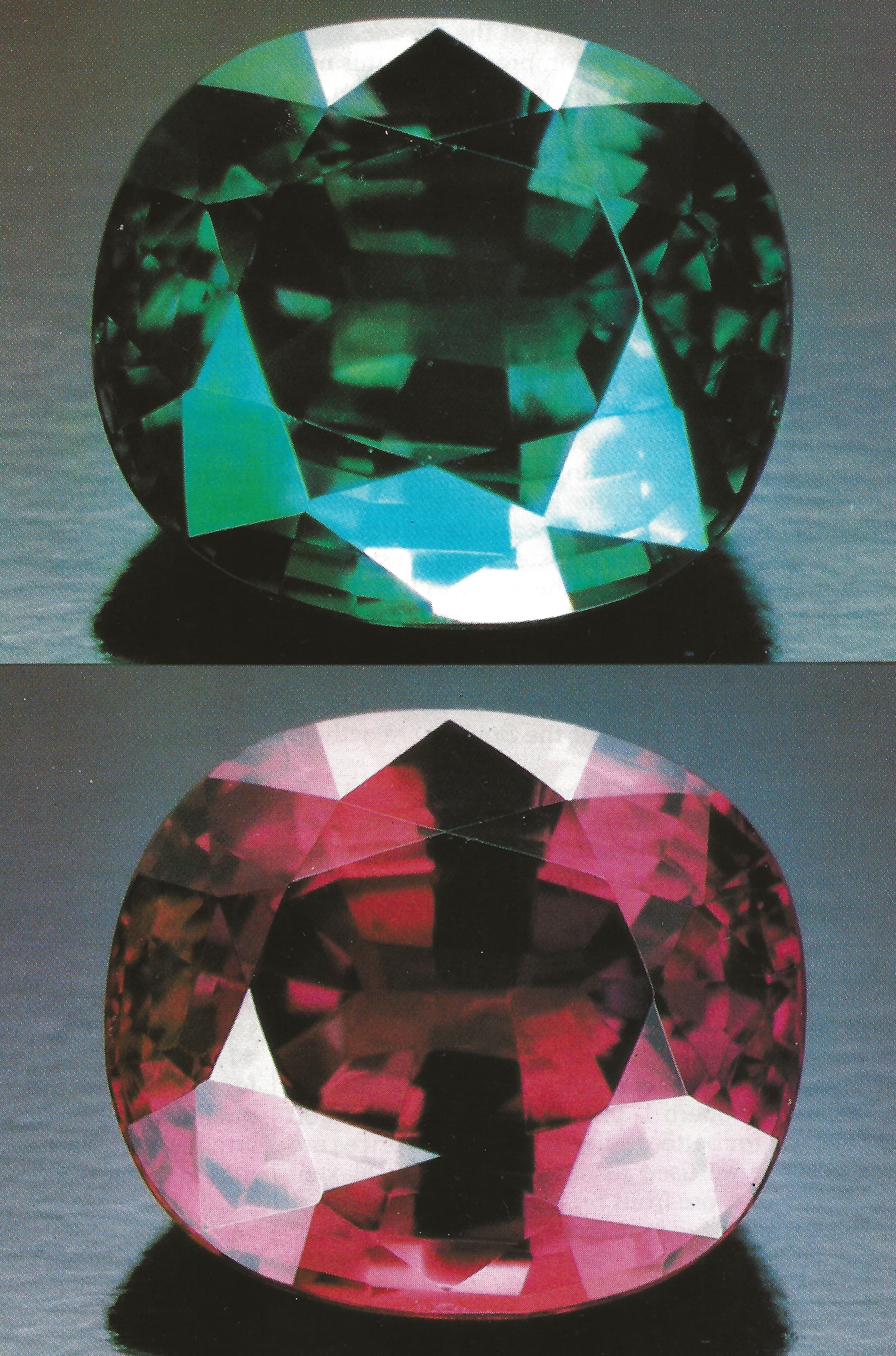
Caesar Habib, a Los Angeles-based specialist in Brazilian gems, still can’t forget the moment this past May he confirmed the rumors he’d been hearing for months about a spectacular find of alexandrite in Minais Gerais, Brazil’s province of gem plenty.
“A dealer showed me a 400-piece parcel weighing 126 carats of which 35 stones were between 1 and 2½ carats,” he recounts. “That was way more than all the alexandrite I had seen in the previous five years.”
But the parcel wasn’t only good news from a quantity standpoint. It was equally impressive from a quality standpoint, too.
“The best of the stones were as good as, if not better than, any pieces I had ever seen,” Habib continues. “I understood at a glance why Brazil’s new alexandrite deposit is the most talked about colored stone find of the decade.”
Other dealers swaddle their first impressions of this new-lode color-change chrysoberyl in similar enthusiasm. It’s hard not to once you see some – and realize that what is easily the world’s most glorified connoisseur gem now has its first-ever chance to score big with commoners, too.
New prestige for Brazil
Until the discovery of its new alexandrite vein, Brazil commanded little or no respect as an alexandrite producer. For prized stones, the trade counted on Sri Lanka, and then only on a sporadic basis. Even at that, Sri Lanka’s best were rarely, if ever, judged comparable to the best of the breed found in Russia.
Alas, practically all of Russia’s stones were mined during the 19th century, possibly some in the early 20th century, too. Given the superiority of the Russian-variety alexandrite, it was only fitting this gem derived its name from Czar Alexander II, who, writes Robert Webster in his masterpiece Gems, came of age the year, 1830, the gem was first discovered in the Ural Mountains. Since then, Russia has been considered the supreme source of alexandrite and dealers have hoped a time would come when the Soviet Union resumed mining this gem. No wonder, then, we sometimes hear a rumor, invariably false, that the Soviets are actively prospecting for alexandrite.
Just in case they are, however, the news from Brazil may prompt them to put down their picks and shovels. Most dealers familiar with the new Brazilian alexandrite swear the best of it surpasses any Russian stones they have ever seen. If enough people eventually share this conviction, a distinct possibility, the gem shibboleth that holds Russian alexandrite the exemplar for this species will be shattered – and with it the rationale for the hefty prices fine Russian alexandrite commands.
Already prices for new-find Brazilian alexandrite are scaling the heights. Dealers are charging $6,000 to $8,000 per carat for excellent to superb 1- to 2-carat stones and $3,000 to $6,000 per carat for better-to-fine stones. Such prices are on a par with those we used to hear reported for alexandrite of 10 carats or more from Sri Lanka, the second-spot source for this gem. Indeed, one dealer who earlier this year sold an exceptional 20-plus carat Ceylonese stone at $9,000 per carat breathes a sigh of relief that he sold the stone just before news broke of the Brazilian find. “It was a fine stone by Sri Lankan standards but not in a league with what I’ve been buying recently from Brazil,” he confides.
Anatomy of an advantage
As anyone who has seen the new alexandrite knows, these stones challenge common experience with this species. Although famous for changing color from green in sunlight to red in incandescent light, few alexandrites actually make a full-fledged color change. Usually there is bleed-through from one color state to another or too much color impurity to start with to permit any significant change. Because total color-change alexandrites are so very seldom seen, the trade thinks it axiomatic that such rarity must be the case for this species.
Now Brazil seems poised to raise trade expectations considerably. For 100% color change is something at which new-find Brazilian alexandrite excels. “The completeness of the color change in most of the material is one of the most amazing things about it,” says Roy Albers of Jones and Woodland, the loose stone subsidiary of Krementz and Co., Newark, N.J. “In Sri Lankan stones, there always seems to be an undertone of secondary brown or yellow.”
Furthermore, the Brazilian stones boast admirable color purity and richness. Greens in smaller sizes tend to be yellowish while those in larger stones are bluish. The reds in smaller sizes Albers compares to the violet color of rhodolite while that in larger stones he likens to rubellite.
The joys and sorrows of plenty
There are other virtues that endear Brazil’s new-find alexandrite to dealers, especially its better-than-usual clarity. But by far the most oft-cited plus after color change is availability. Nobody knows how much material has been cut. But insider estimates range from 5,000 to 10,000 carats, a staggering number for a gem as rare as alexandrite. What’s more, a significant amount of cut stones, some think as much as 30%, are 1 carat or more in size.
All this spells plentitude – albeit with some relativity – for a gem never thought of as plentiful. And that’s got some dealers worried. “Half the charm of alexandrite to collectors is its rarity,” says one New York fine gem specialist. “Since collectors are the backbone of the alexandrite market, will ready availability of fine specimens chase them away? And if so, what will that do to prices?”
Those are good questions, ones it is far too soon to answer. At present, the new-find alexandrite mining area, known as Nova Era City, is closed after some bloody claim site disputes.
Nevertheless, most dealers expect mining to re-commence and production to continue on the hearty side for at least a few more years. And while it is true that continued large production could rattle connoisseurs, dealers feel the opportunity to mainstream alexandrite would more than compensate for any loss of collector interest.
It’s hard not to second that opinion. At prices between $1,800 and $2,000 per carat, or $600 to $1,000 per piece, for semi-abundant ⅓ to ½ carat stones in better to fine qualities, the public could well afford to pay alexandrite the attention it deserves. As Albers puts it: “The new alexandrite deposit is a dream come true.”
The 1.06-carat Brazilian alexandrite shown on the preceding page is courtesy of Mayer & Watt, Beverly Hills, Calif.