Blue Topaz
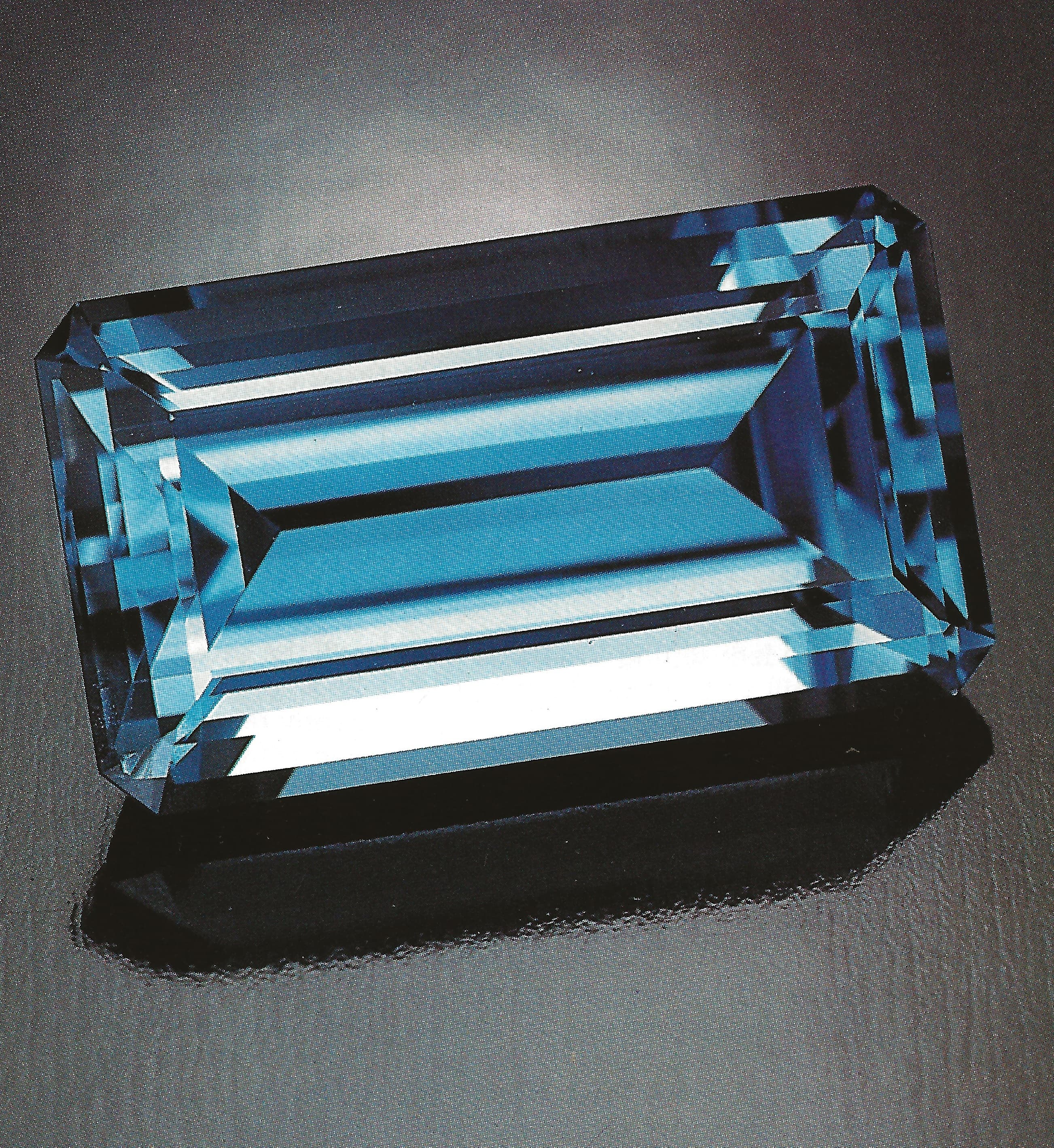
Dealers don’t like to admit it, but blue topaz has given aquamarine, its blue beryl brother, a hard time in the last year.
Indeed, lighter-shade aqua that once fetched $150 per carat has dropped considerably below $100 per carat because look-alike blue topaz was selling readily for $4 per carat. Consumers who couldn’t see any difference between the two stones, but price took to topaz.
So did jewelry manufacturers, especially when they realized that, for $8–$10, they could buy all they wanted of deeper-shade blue topaz that rivaled $400–$600 per carat aqua in color intensity.
As a result, a lot of aqua sellers had to add blue topaz to their inventories in the last year. And it is safe to assume that many more will do so.
Incredible as it may seem, blue topaz has become one of the two or three biggest selling non-traditional colored stones in this country. According to a leading importer of this gem, Pete Flusser of Overland Gems, Los Angeles, it is also beginning to catch on in Europe and Asia too. “American dealers are starting to export blue topaz all over the world,” he says.
What makes the blue topaz blitz so important from a historical perspective is that this stone is the first irradiated gem other than diamond that has been openly marketed as such to score heavily with the public. This means industry and consumer attitudes about treated natural gems are changing radically. As Flusser puts it: “Irradiated blue topaz is not regarded as a novelty stone but a full-fledged gem. It’s as beautiful as it is affordable.”
For both its beauty and price, blue topaz is indebted to atomic energy. Treaters here and abroad are taking kilos of colorless to near-colorless Brazilian topaz and turning them into various colorful blues via a two-step process of irradiation (which incites color change) and heating (which stabilizes the change). The degree of color depends on the high-energy source used – whether reactor, gamma cell or electron accelerator.
But while sales of this precedent-setting irradiated gem stay brisk, many dealers are still ambivalent about it. They sell blue topaz as an accommodation. “My heart just isn’t in it,” confesses Alex Bahtiarian, Englewood, N.J.
Baked vs. bombarded color
Blue topaz isn’t the first stone to owe its popularity to treatment. Ironically, aqua, its biggest color competitor, rarely occurs in all-blue shades. Stones are heated to remove green.
Understandably, however, heating is more acceptable to the trade than irradiation. The fact that some early batches of reactor-treated blue topaz were brought into this country in a radioactive state only added to dealer fears. Few in the trade are aware that other bombardment techniques such as gamma and electron treatment pose no health hazards whatsoever. What is more, U.S. law requires any treated material with radioactivity above certain very low levels to be quarantined – until readings of radioactivity drop almost to an undetectable level.
But “hot” stones brought in by foreign dealers have presented problems. For this reason, all importers we know of who regularly buy and sell irradiated stones check them with Geiger counters. Such routine checks have by now deterred almost all attempts to sell radioactive topaz.
To further reduce danger, however, a growing number of U.S. dealers are importing topaz rough in its virgin state and treating it here. Methods used involve both residual and non-residual radiation. But whenever there is residual radiation, stones are quarantined until safe. By the way, some methods used, such as gamma cell treatment, are the same as those used to sterilize food stuffs and surgical instruments.
Thus, industry distrust of irradiation may be beginning to ebb. But while irradiation may be considered safe, it is still often considered “unnatural.” Several importers who sell both aqua and blue topaz told us the color of the latter stones were lovely but somehow “fake.”
Treaters think this reaction is more psychological than aesthetic. They note that tanzanite, a brownish-purplish zoisite heated to turn a desirable blue, is rarely found naturally in its blue state. So, what’s the difference, they ask. Traditionalists insist there is a difference. “We don’t classify aqua and tanzanite for specific color types the way we do blue topaz,” Bahtiarian says. “This stone just doesn’t have the subtle variety that heated stones do.”
The birth of the blues
To hear dealers describe irradiated blue topaz you might at first think you were looking through a book of paint chips.
But dealers who themselves irradiate stones tend to associate basic colors with basic bombardment techniques. They are simply talking like treaters.
For Pete Flusser, there are two basic hues – “London blue” and “sky blue” – that are most in demand today. “London blue” is the product of reactor treatment. This method is most commonly used to induce a deep blue color (often with a bit of gray) in smaller stones from 1 carat down. Unfortunately, due to the length of time required for treatment and later decontamination, final cut stones cost $12–$15 per carat – far more than for stones treated in other manners.
“Sky blue” stones, on the other hand, cost $10 per carat tops – at least, from prime source dealers. Treated in linear accelerators, these stones, at their best, match in color depth that of very fine aqua. But such match-up stones are still the exception to the rule. Flusser says they account for 25% of the stones he treats. The remaining 75% more nearly resemble medium-color aqua costing between $150 and $400 per carat.
Occasionally, dealers will be shown dark steely electric-blue topaz reminiscent of those that first hit the market in the mid-1970s. At that time, the finest irradiated topaz commanded as much as $40 per carat. Today the highest price quoted to us was $20 per carat – and this is for far-improved color.
Nonetheless, jewelers who tend to think of blue topaz in the same way they do cubic zirconia may be reluctant to buy this natural stone. “They figure that as more people sell it and more comes on the market prices will drop drastically,” Flusser says.
But blue topaz may be at or near its floor price.
The demand for colorless topaz rough has forced prices for this material up in the last year. At the same time, increased demand for treatment has also encouraged irradiators to push up their prices.
“I think the days of good-color $4 per carat blue topaz are numbered,” says Pete Flusser. “Some stones cut poorly in Brazil may be dumped. But other dealers will snatch them up, first for retreating and re-cutting, and then sell them for a better price.”