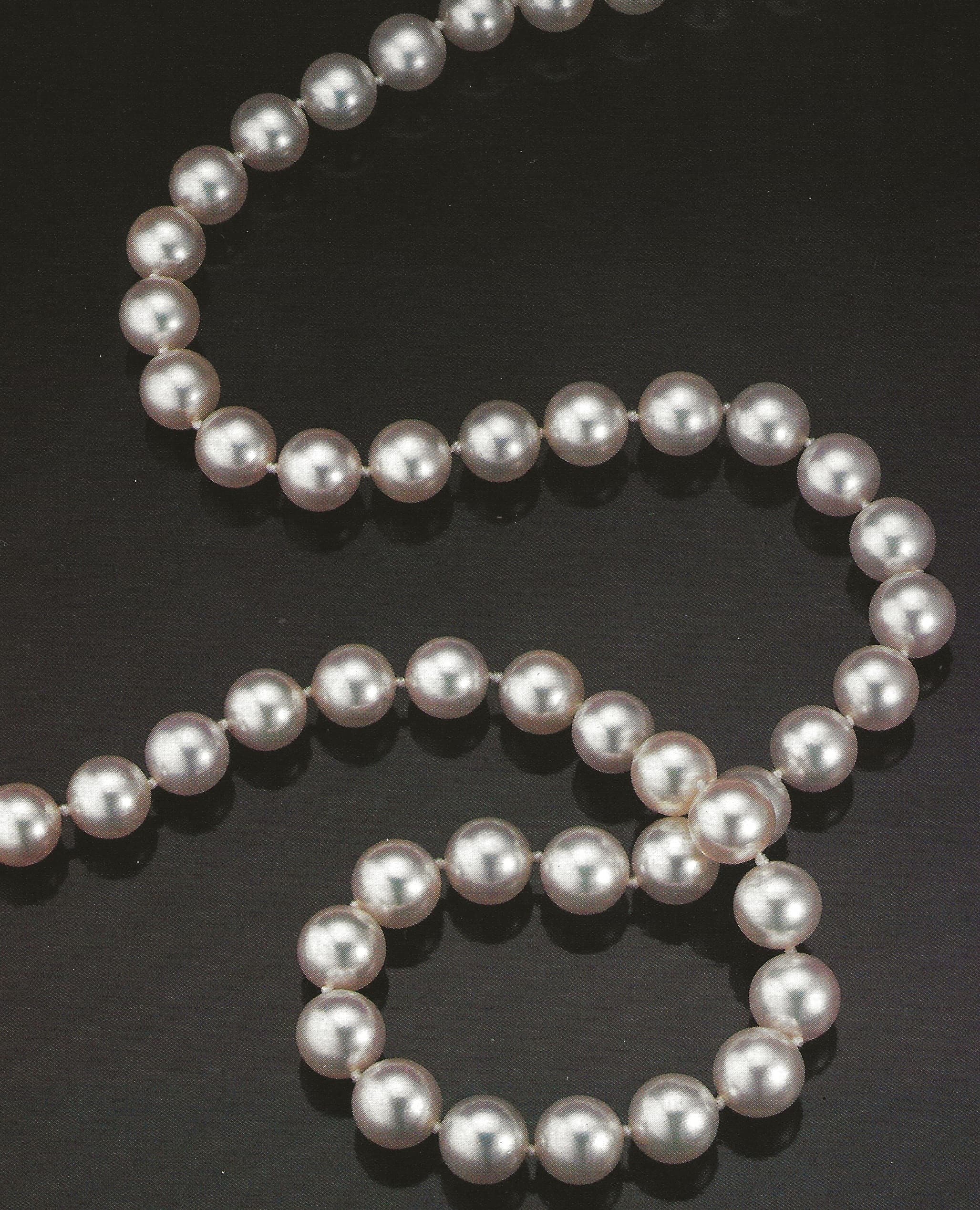
Akoya Pearl
According to Islamic mysticism, the first thing God created was a tablet on which was recorded every event that would ever take place until Judgment Day. Next, God created a perfect sphere some 70,000 leagues in size with 70,000 tongues to sing His praises that He turned into the mighty ocean from which all life emerged. Both the tablet and sphere were made of pearl.
Given such veneration for this organic gem, it is hardly surprising that for centuries men dreamed of systematically forcing oysters to grow more pearls – rather than leave production to the highly selective whims of nature. Experimentation with pearl culturing is recorded as far back as the 12th century.
But it wasn’t until seven centuries later, in the 1890s, that two Japanese working independently of each other discovered a workable pearl culturing method, one that took until 1908 to perfect. Using this method, Japanese pearl farmer Kokichi Mikimoto, to pearls what Henry Ford is to cars, introduced the Japanese akoya (meaning: cultured) pearl in 1919. For years thereafter, Mikimoto was a one-man De Beers for pearls, his farms credited with at least 75% of the gem’s entire world production.
Today, the cultured pearl market has many more than one kingpin. But it is still tightly controlled by the Japanese whose akoya-variety harvests account for at least 70% of annual pearl production. Almost all of the remaining 30%, much of it from China and the South Seas, is also cultured in one way or another. Yet purists still consider the cultured pearl a manmade gem.
It isn’t. True, the pearl is provoked by man not nature when live mollusk mantle tissue, along with a sizeable spherical bead nucleus cut from a Mississippi drainage area mussel shell, are inserted into the oyster. But such intervention alone doesn’t make the cultured pearl non-natural, not when you realize that pearl farmers think themselves lucky when 20% of their implanted oysters grow pearls. If all goes well, a big “if” left largely to nature, the implanted mantle tissue will shortly envelop the bead and that will, in turn, trigger layerings of nacre (mother of pearl) around the nucleus by the host oyster. Several hundred layerings are needed for a decent pearl, a thousand or more for top grades.
Unfortunately, decent nacre buildup takes at least three years. Well into the 1950s, says John Bucher of Golay Buchel USA Ltd., New York, “three-year growing times were still the norm in Japan and four- and five-year cycles common.” To meet unprecedented demand in this decade, average pearl growing times, already trimmed to two years, were whittled further to 18 months, even less. The end result: a highly predictable and publicized flood of substandard pearls. As their meager nacre coatings wore off, consumer confidence wore out. Now, say dealers, the deluge is ending and the Japanese are pledged to quality again.
Problematic Promise
Pearl culturing standards aren’t what they used to be. Greed is as much to blame as nature. Besides abbreviated growing times, the tank-bred pearl oysters used nowadays are less hardy than those once taken direct from the sea. Overcrowding waters with these oysters only weakens them more by putting greater drain on nutrients. Add to this a typhoon or two, as well as increased pollution, and the chances of a banner pearl crop furl even more. No wonder the Japanese talk seriously about transferring the pearl culturing process from the sea to the laboratory.
Meanwhile, the Japanese must contend with conditions far less conducive to growing the lustrous cultured pearls that nearly 70 years ago so easily stole the thunder of the nature variety. Those pearls required great skill to identify by eye (now it’s done in seconds with X-rays). Gem dealer Maurice Shire even tells a Zen-like story of the day that he finally developed, after years of trying, “the sixth sense” to distinguish natural from cultured pearls. Don’t get us wrong. Magnificent, cultured pearls are still produced. But now when quantity is stressed over quality some connoisseurs fear that the truly fabulous akoya pearl may one day be as rare as the natural pearl it replaced.
The Japanese defend their recent growing practices by saying they were only meeting a seemingly insatiable demand for low-end pearl strands. That demand intensified when the dollar began to plunge against the yen in September 1985 and retailers felt constrained to stay within certain inflexible price boundaries. To their credit, the Japanese tried to hold the line on prices and today continue to absorb a hefty share of continued dollar devaluations. Yet the temptation to cut corners is undeniable. How else does one explain the fact that tens of thousands of reject pearls, ordinarily barred from export by Japan’s pearl inspection office, have made their way to transshipping centers such as Hong Kong, the United States and Europe?
U.S. pearl importers assure us that dumping here of pearls-in-name-only strands is about over. But daily newspapers still carry ads, many from reputable jewelers, of “magnificent” 6–6½mm pearl strands in fashionable 18-inch lengths for $100 to $200. “I couldn’t afford to sell my commercial strands at wholesale for such prices,” complains Old Schultz-Pedersen of Schoeffel USA, New York.
The 4Cs for Pearls
Weakened public confidence in pearls may have a beneficial side. Following De Beers’ lead, dealers now seriously entertain a pearl quality advertising and public education program similar to the very successful 4Cs campaign for diamonds. What’s more, there is talk of adopting an industry-wide pearl grading system in the United States that would make price and quality comparisons far easier for retailers and consumers. But even without such innovations, says Alex Edwards of Abachi America Inc., Los Angeles, “The whole problem with substandard goods could be eliminated if jewelers became familiar with pearl quality.”
Gaining such familiarity is not difficult. Pearls, like diamonds, lend themselves to grading, especially since American color and shape preferences fall into very narrow ranges: cream-rose to pinkish colors and round shapes almost exclusively. With a minimal investment, say $500, Edwards, a former diamond instructor at the Gemological Institute of America, urges jewelers to incorporate sets of five-pearl “master stands” into selling. These strands permit jewelers to show the progressive impact on price and quality of compromising pearl size, luster (a function of nacre thickness), roundness or spotting (degree of surface blemishing) – “essential factors other than color and shape where the leeway is broader,” Edwards says, “The point is this: let people see for themselves the cut-offs in quality for strands. Junk pearls only look good in a vacuum.”
The akoya pearl strand is courtesy of Adachi America, Los Angeles.